With her sister Margaret, Christine is the co-founder of the Institute For Figuring (IFF) is an organization based in Los Angeles promoting public understanding of the poetic and aesthetic dimensions of science, mathematics and the technical arts. The Institute hosts public lectures and exhibitions, publishes books and maintains a website. Projects include exhibitions of The Logic Alphabet by Shea Zellweger, The Business Card Sponge by Dr Dr Jeannine Mosely, Physics on the Fringe, and the Crochet Cactus Garden, (see images below)
Crochet Coral Reef https://crochetcoralreef.org/
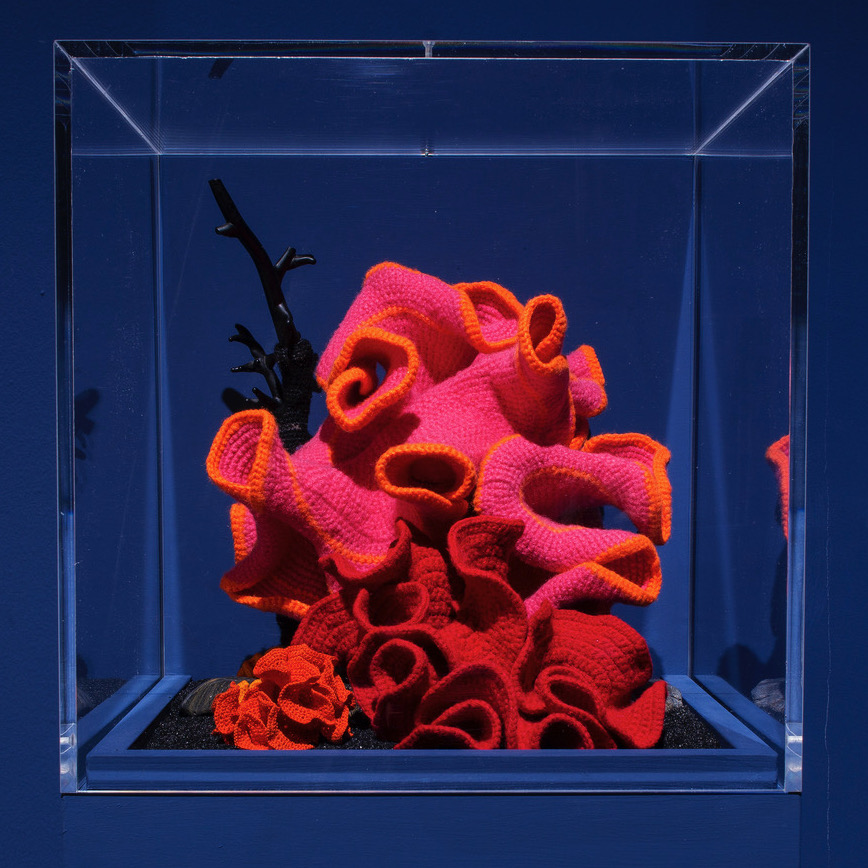
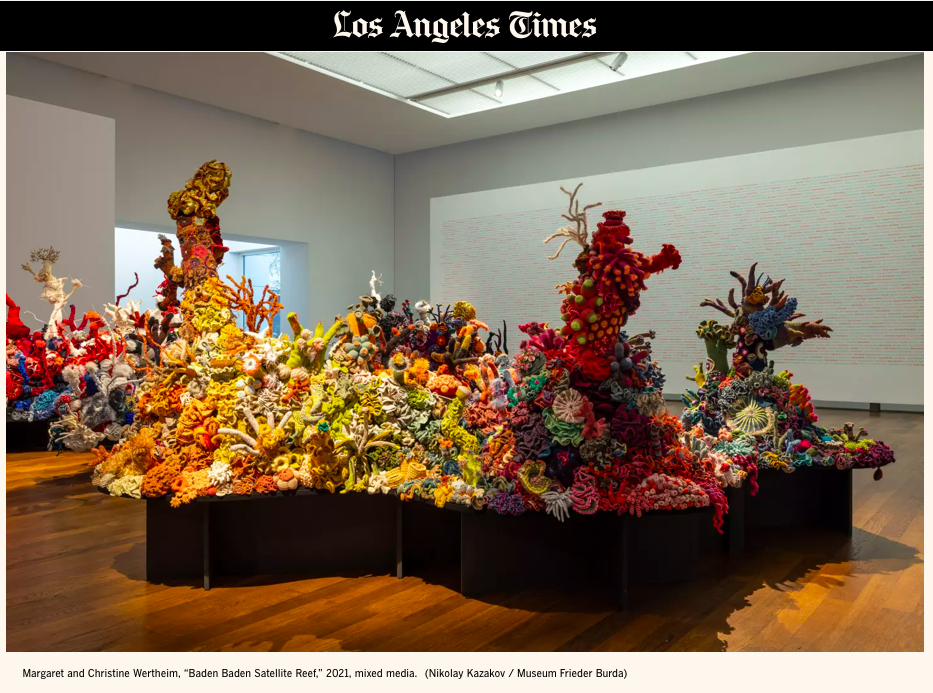
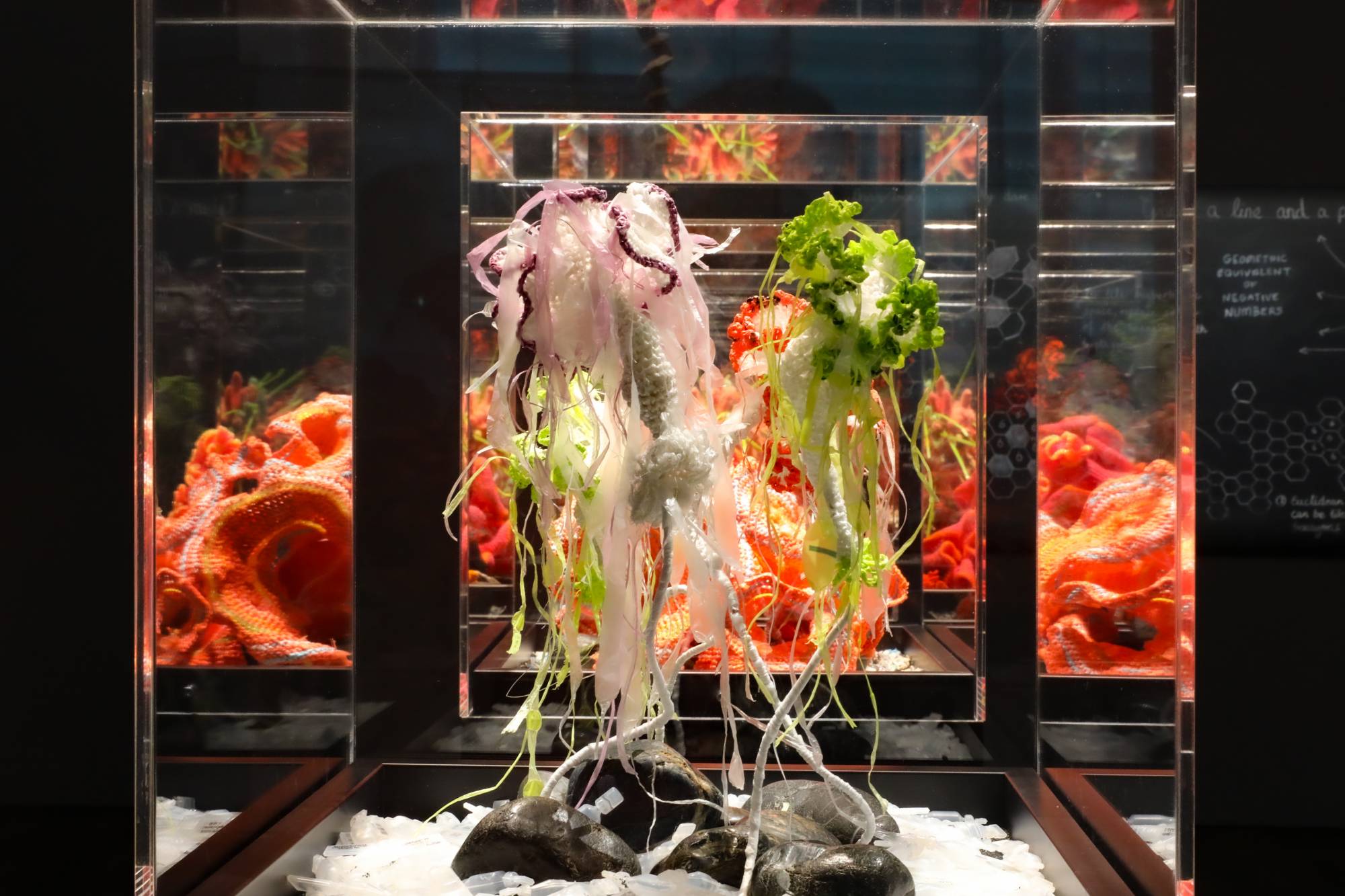
In 2005 the IFF began its largest project to date, he Crochet Coral Reef, a 20 year global experiment in applied mathematics, community art, evolutionary theory and craft practice, conducted through a feminist lens. It now has over 30,000 participating citizens in 53 cities and countries. The work has been shown at international venues such as the Hayward Gallery (London, 2009), Museum Frieder Burda (Germany, 2021), the Venice Biennale (2019), Helsinki Biennial (2021), and Schlossmuseum Linz (2023, 2024). It has yielded two monographic books, and has been written about widely in academic contexts and the mainstream press, including The New York Times and Guardian. Many feminist scholars have covered the work, among them Donna Haraway (in Staying with the Trouble) and Eva Hayward. In August 2026, the project will be exhibited at MIT Museum.
Praise for the Crochet Reefs
“Gorgeous, absurd, and socially productive, these are rare works of art.”
–Christopher Knight, Los Angeles Times
In 2005 the IFF began its largest project to date, to crochet a coral reef. Today more than 7000 people have joined in creating this ever-growing plastic and woolly wonder. More than 25 Crochet Reefs have been made around the world – in New York, Chicago, London, Melbourne, Oslo, Arizona, Indiana, Ireland, Germany, Latvia and elsewhere.
This vast handmade archipelago – resulting from more than 200,000 hours of human labor – is one of the most extensive community artworks ever. Collections of Crochet Reefs have been shown at major art galleries and science museums worldwide, including the Chicago Cultural Center, the Hayward Gallery (London), Science Gallery (Dublin) and the Smithsonian’s National Museum of Natural History (Washington DC).
“Hooray for all the work, play, thought, and precious bodily fluids that went into making this ongoing art!”
–Donna Haraway, Science + Technology Studies Scholar, UC Santa Cruz
“The AIDS Quilt of global warming.”
— Lawrence Weschler, New York Institute for the Humanities
Interview with Margaret and Christine Wertheim about the Reef project – in The Believer
Recent Reef Exhibitions
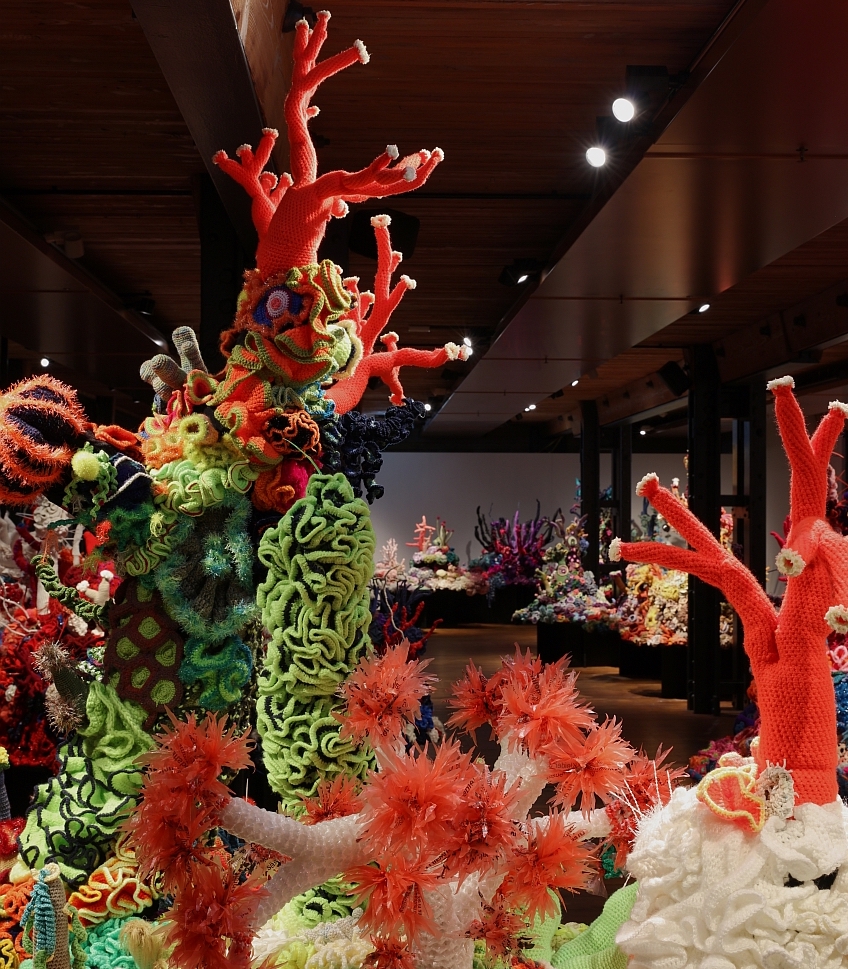
Expedition to the World’s Oceans, Bundekunsthalle, Bonn, 2026
Migrations and Climate, Palais de la Porte Doree, Paris, 2026
Corals: Play of Colors in Art and Science, International Maritime Museum, Hamburg, 2025
Threads of Change: Design and Data, Museum of Design Atlanta, 2025
Pittsburgh Satellite Reef, Carnegie Museum of Art, 2025
- Leonardo da Vinci, the Codex Leicester, and the Creative Mind, Minneapolis Institute of Arts
- Night Begins the Day, Contemporary Jewish Museum, San Francisco
- Crochet Coral Reef, Southwest School Of Art, San Antonio, Texas
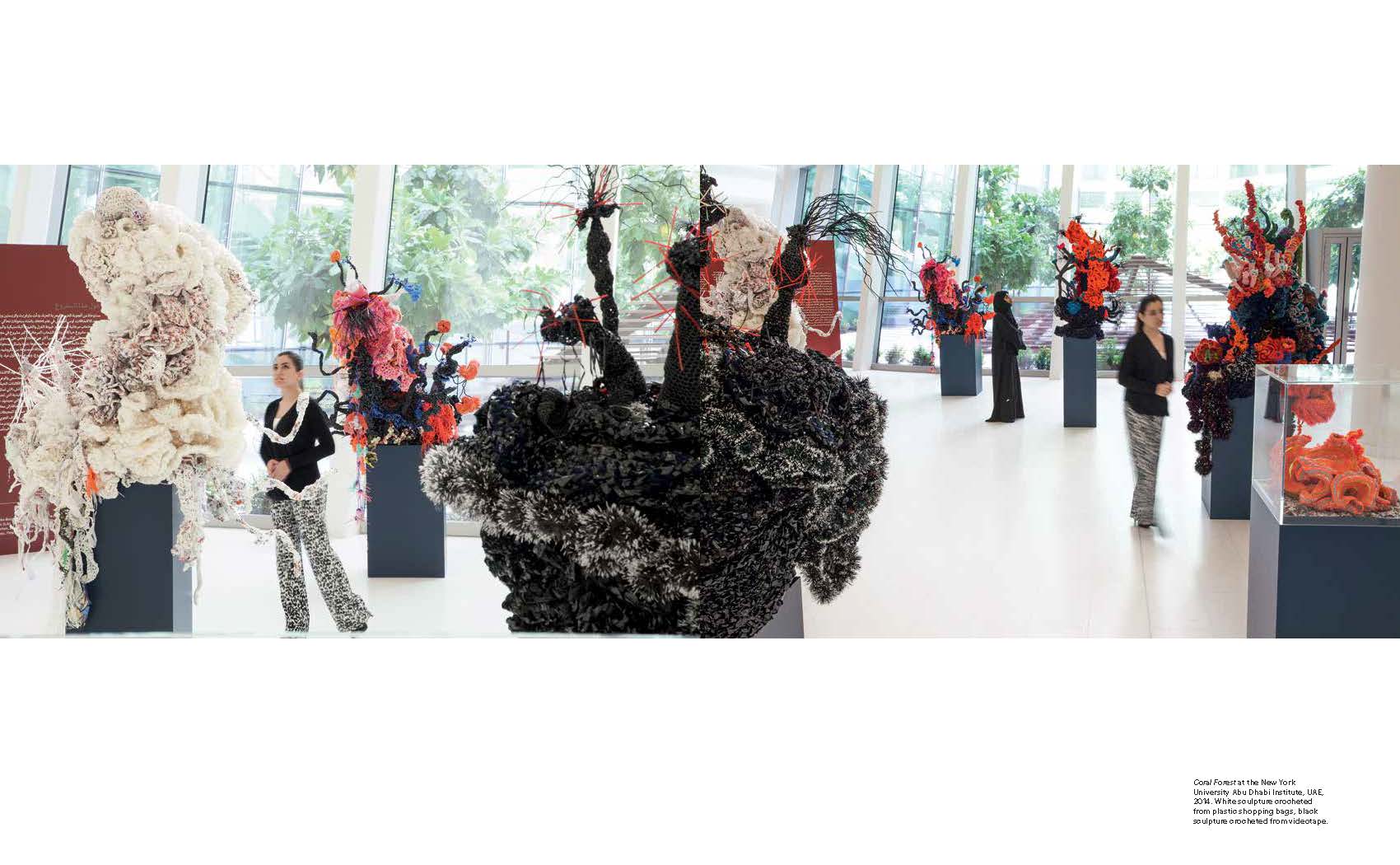
- Crochet Coral Reef, New York University, Abu Dhabi Institute, UAE
- Hyperbolic: Reefs, Rubbish, and Reason, Art Center College of Design, Pasadena, California
- The Hyperbolic Crochet Coral Reef, Sant Ocean Hall, Smithsonian, Washington, D.C.
Some Reef Reviews
Nature (Feb 11, 2021). Art Graft: Putting an “A” into “STEMM” essay about scientists using art as an aid to creativity, featuring the Crochet Coral Reef.
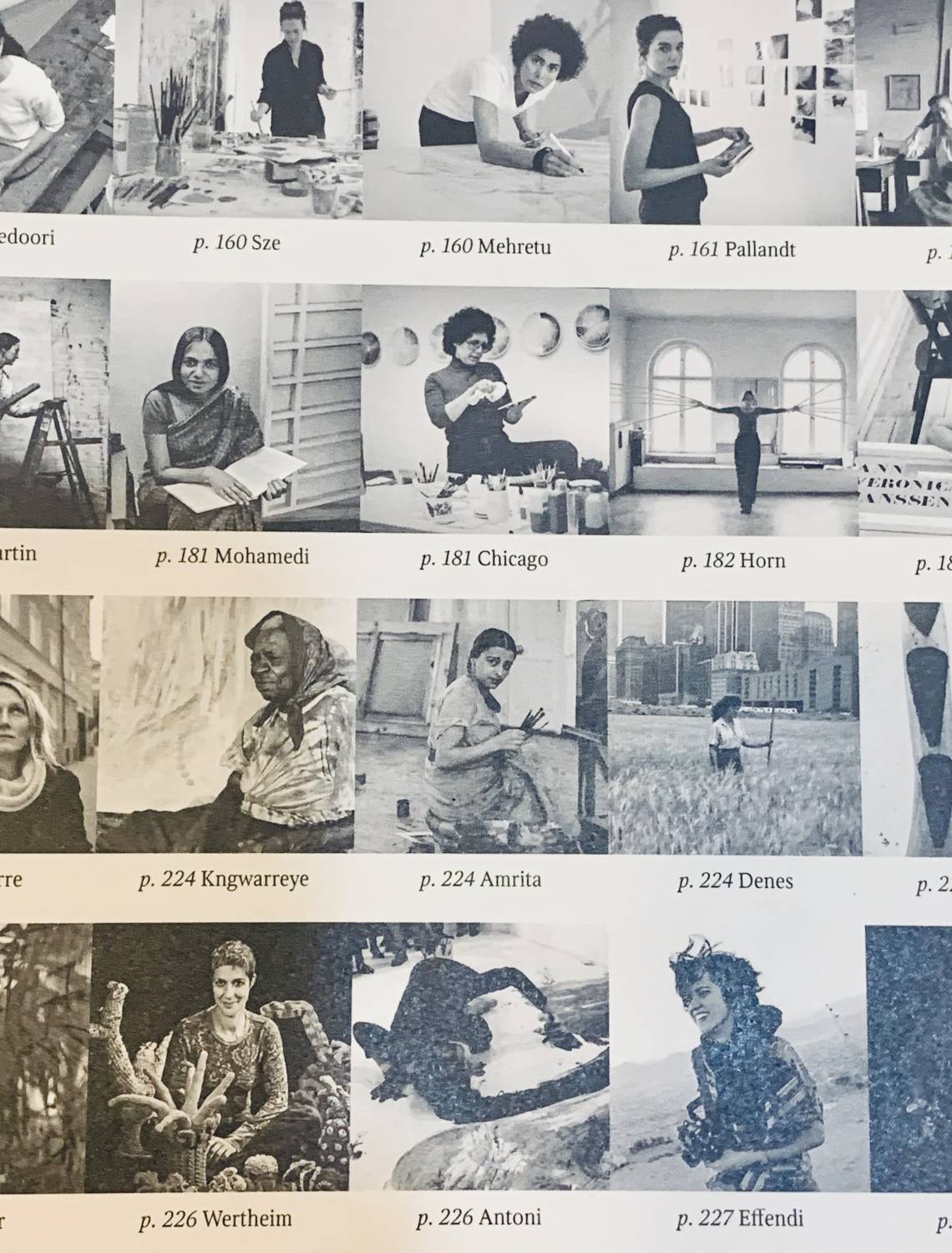
See All This, Winter 2020/2021 – special international edition of Dutch art journal See All This celebrating women artists, edited by Catherine de Zegher. Featuring Crochet Coral Reef creators Margaret and Christine Wertheim


On Being – NPR radio
The Grandeur and Limits of Science – Krista Tippett interviews Margaret Wertheim.
To The Best of Our Knowledge – NPR radio
Is the Universe a Number? – Anne Strainchamps interviews Margaret Wertheim.
Antennae: Journal of Nature in Visual Culture
Journal editor Giovanni Aloi interviews Margaret Wertheim about the Crochet Coral Reef and art+science practice.
Marg Magazine
Essay about the Crochet Coral Reef and feminist ecological art practice by Heather Davies.
Indyweek.com – Sea Sick: The Crochet Coral Reef project heightens our sense of responsibility to the oceans, essay by Eva Hayward
Guernica
Margaret Wertheim: At Home in the Universe. Interview by Tega Brain, on gender bias in science, and inventing new geometric forms through crochet.
Lenny Letter
Interview with Margaret Wertheim by Rose Lichter-Marck.
Artillery – Review of Crochet Coral Reef book by Dough Harvey
Huffington Post – article on the Crochet Coral Reef as public art
Christopher Knight, LA Times – review of ‘The Loop Show’ at Beacon Arts Building
Bomb – Artists on Artists: Christine and Margaret Wertheim
A Journal of Feminist Cultural Studies – Sophia Roosth’s essay in the Crochet Coral Reef, “Evolutionary Yarns in Seahorse Valley: Living Tissues, Wooly Textiles,Theoretical Biologies”
Science Magazine – article on the Crochet Coral Reef project
The Washington Post – article on The Crochet Reef
Smithsonian Magazine – article on the Hyperbolic Crochet Coral Reef project
[ cover ]
Wired – article on The Crochet Reef
New York Times – article on The Crochet Reef
The Guardian – article on The Crochet Reef
The Times (UK) – article on Hyperbolic Crochet
Los Angeles Times – article on The Crochet Reef
X-TRA – review of Crochet Reef
……………………………………………………
Other IFF Projects and Exhibitions
THE LOGIC ALPHABET OF SHEA ZELLWEGER
Curated by IFF co-director Christine Wertheim
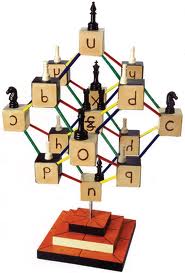
In 1953, while working a hotel switchboard, Shea Zellweger began a journey that would culminate in a radical new notation for formal logic, the set of relations that underlies modern computing. From a garage in Ohio, Zellweger developed a visual language he dubbed the “Logic Alphabet,” in which a group of specially designed letter-shapes are maneuvered like puzzles to reveal the geometric patterns hidden beneath the symbolic web of logic. For more than fifty years, Zellweger has been exploring the symmetries and relations inherent in these patterns, which he has made manifest in a series of delicately crafted wooden models and in thousands of pages of diagrams. In this jewel-box exhibit, the Institute For Figuring and the Museum of Jurassic Technology proudly present Dr Shea Zellweger’s Logic Alphabet models and drawings.
This exhibition was shown from March 3, 2007 to March 1, 2012 at the Museum of Jurassic Technology.
See also: Cabinet, Issue 18, Summer 2005
THE BUSINESS CARD MENGER SPONGE
by Dr Jeannine Mosely
A collaboration between the Institute For Figuring and Machine Project
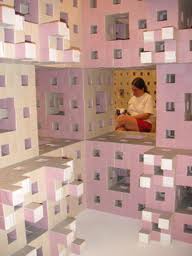
Menger’s Sponge – named for its inventor Karl Menger and sometimes wrongly called Sierpinski’s Sponge – was the first three dimensional fractal that mathematicians became aware of. In 1995 Dr Jeannine Mosely, a software engineer, set out to build a Level 3 Menger Sponge from business cards. After 9 years of effort, involving hundreds of folders all over America, the Business Card Menger Sponge was completed. The resulting object is comprised of 66,048 cards folded into 8000 interlinked sub-cubes, with the entire surface paneled to reveal the Level 1 and Level 2 fractal iterations.
This exhibition was shown from August 26 – September 24, 2006 at Machine Project.
The Inaugural Exhibition at the Institute For Figuring’s new space.
What drives a man with no science training to think he can succeed where Einstein and Stephen Hawking have failed? In the Institute For Figuring’s first suite of jewel-box-like exhibitions, the main gallery will feature Physics on the Fringe, an exploration of alternative theories of the universe by geniuses, mavericks and outsiders from the nineteenth century to today. The exhibit celebrates the amateur spirit of inquiry, putting into historical context the individual impulse to understand our universe. Continuing the IFF’s commitment to participatory programming, visitors are invited to peruse our unique collection of both insider and outsider physics theories, and to write their own ideas about the structure of reality in our exhibition folio.
This exhibition was shown from April 14 – November 10, 2012 at the Institute For Figuring.
CROCHET CACTUS GARDEN
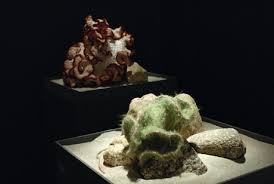
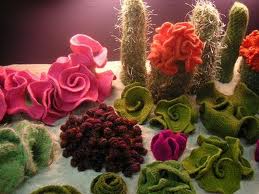
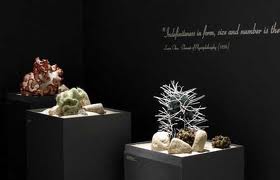
Like their living brethren, crochet cactii are found in a dazzling variety of species, with each individual crafter bringing to bear on the age-old patterns of nature unique asthetic powers. All the forms exhibited here have been inspired by the insights of “hyperbolic crochet” discovered by Cornell mathematician Dr Daina Taimina, yet each contributor has found ways to express within these algorithmic strictures their own expressive designs. In Cedar Hill, Texas, Evelyn Hardin discovered the delights of felting, using variegated soy yarns to produce undulating forms of transcendent loveliness; in Bendigo, Australia, Marianne Midelburg combed thrift stores, turning discarded wools into pebbly piles; in Culver City, Sarah Simons, a master of the floret form, concocted an entire taxonomy of cactus flowers by mixing together mercerized cottons in subtly complimentary hues. In Los Angeles Anitra Menning reigns as the queen of vegetable architectonics, crafting swooping marvels at once fuzzy and firm, while David Orozco (proprietor of That Yarn Store in Echo Park) specializes in soft flanges of green and grey, a predisposition shared by Spring Pace in the wilderness of Topanga Canyon. In Bonnie Doon in rural Australia, Helen Bernasconi, proprietress of a sheep farm, spins and dyes her own wool before painstakingly designing (with spreadsheets no less) mathematically precise clusters evoking the geometry of pincushion cactii. Although none of these forms were created to be together, to us at the IFF, they seemed destined for one another – when we came to curate this exhibition the Garden literally grew itself.
Crochet Cactus Garden , Jackson Hole, WY
The Crochet Cactus Garden, The Wignall Museum, Chaffey College
The Crochet Cactus Garden, The David Weinberg Gallery